Réunion de la communauté francophone d'eLabFTW - Octobre 2026
🌟 Compte-rendu de la réunion de la communauté francophone d’Octobre 2026
Cette réunion de la communauté francophone a été consacrée au retour d’expérience de Romain Goudon sur la structuration des ressources dans eLabFTW au Laboratoire Sol et Environnement de l’Université de Lorraine.
Romain a expliqué comment son équipe de 40-50 personnes a migré de cahiers de laboratoire papier vers le système électronique eLabFTW, commençant par un périmètre restreint en 2023 puis élargissant progressivement la gestion des équipements, méthodes et documentation. L’équipe a actuellement intégré 150 ressources dans le système, permettant une centralisation du suivi des équipements, une meilleure traçabilité scientifique et une organisation adaptée aux besoins de l’unité.
Community Meeting October 1st 2026 Summary
🌟 Summary of the Community Meeting on October 1st, 2026
In the eLabFTW Community Meeting, we focused on templates and the ways in which they can help improve the consistency, efficiency, and quality of research documentation.
First, Nicolas Carpi gave an overview of how to use templates. He showed how to add categories, statuses, tags, text, custom fields, grouped fields, units, steps, attachments, links, and permissions. He also showed how some steps or permissions can be locked, and explained that entries created from templates can be set to inherit permissions automatically. Finally, he discussed creating a template directly from an existing experiment or resource, duplicating templates without edit access, and loading additional custom fields into existing entries.
What's new in eLabFTW 6.0
Introduction
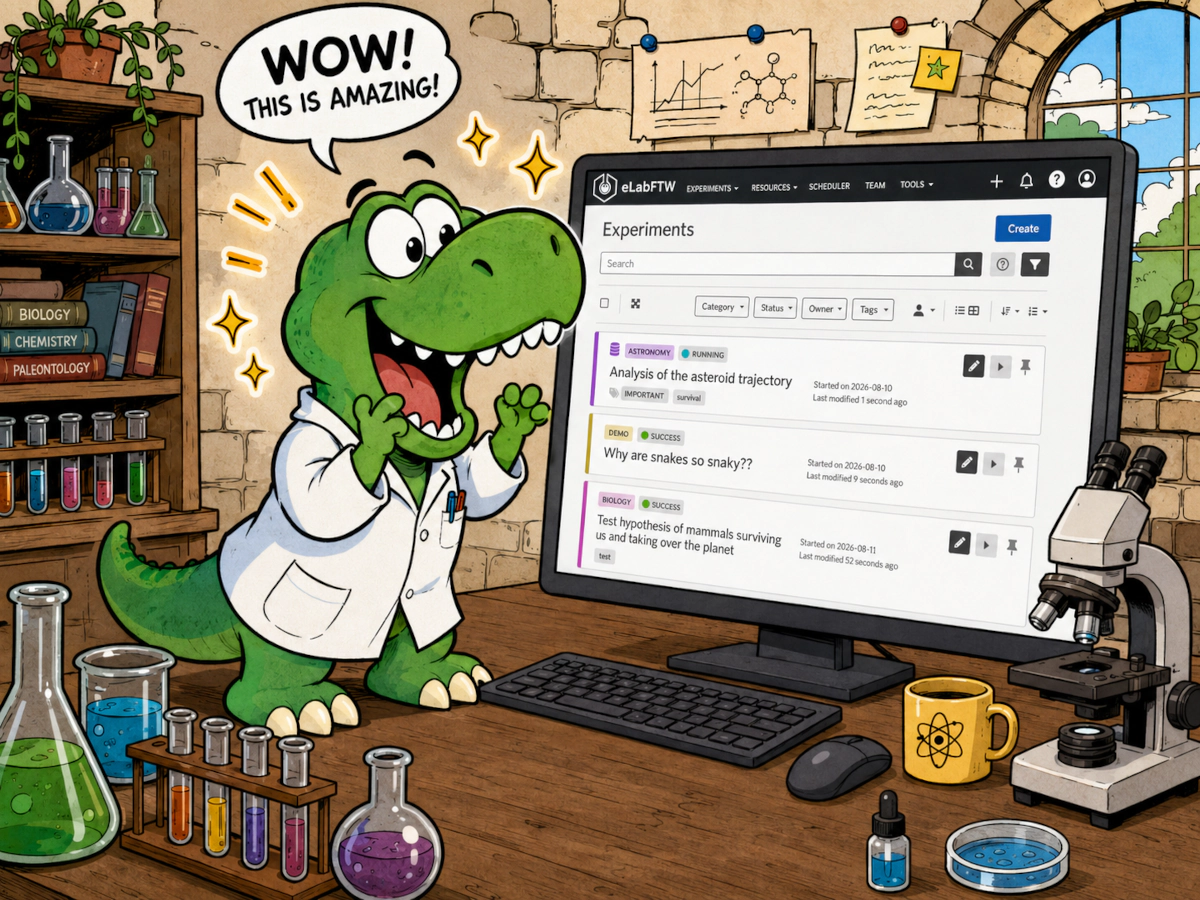
eLabFTW 6.0 is here (or maybe will be here if you are reading this before the final release)!
This is a major release, with a few breaking changes. Make sure to read our post explaining why we introduced breaking changes in this release.
This post is about the new features and the fixed issues that are contained in this new release.
A note about “stable” releases
eLabFTW is a living project — “stable” should not be taken to mean that it is no longer evolving. Version 6.0.0 is production-ready, but minor bugs will surface once it is in wide use, and patches will follow.
eLabFTW 6 and its breaking changes
Why eLabFTW 6 includes breaking changes
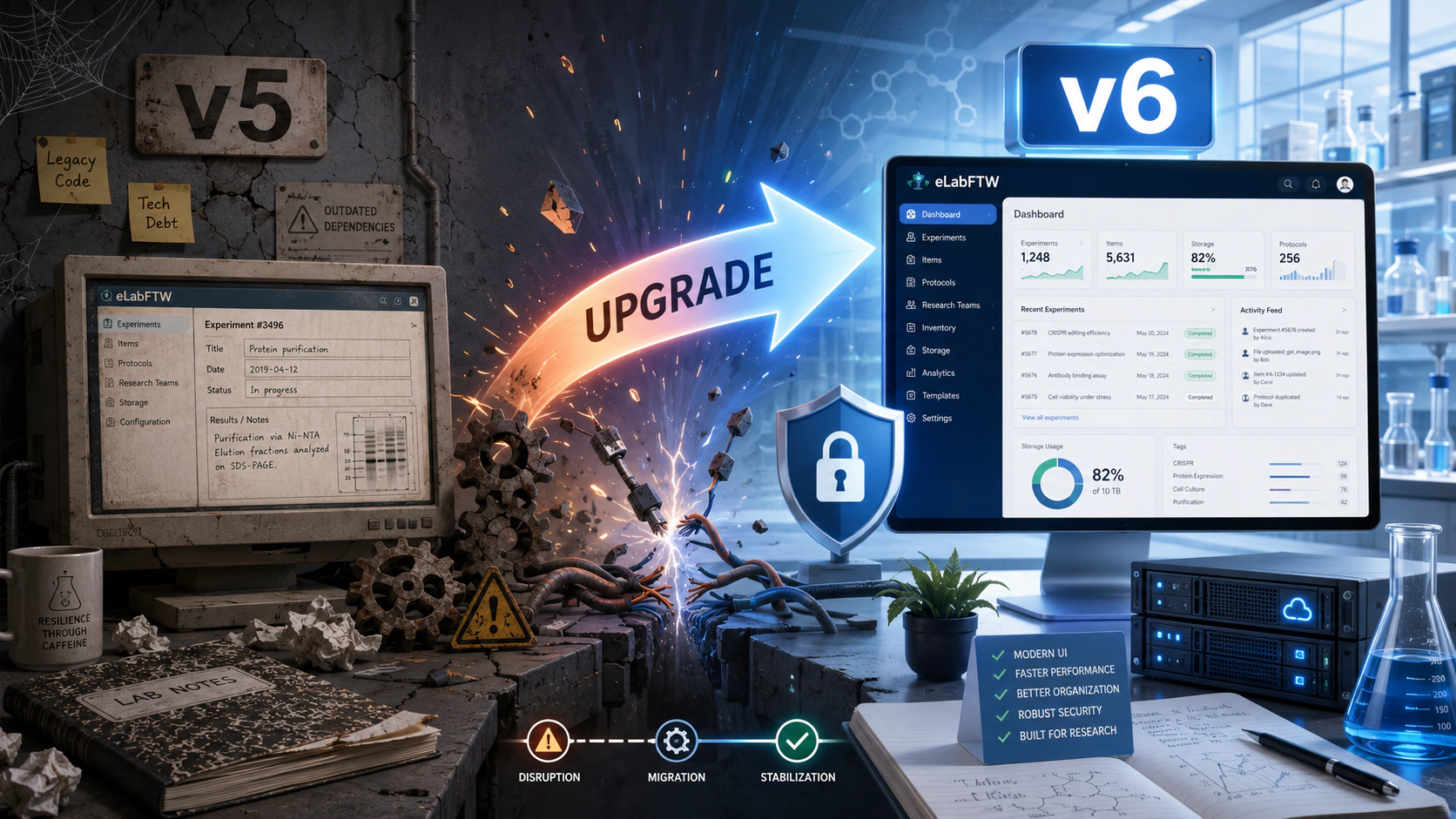
Upgrading software should ideally be straightforward. However, some improvements cannot be introduced without changing assumptions that have existed for many years.
This post explains why eLabFTW 6 introduces several breaking deployment changes, and why we believe the resulting improvements are worth the additional migration work.
The weight of historical decisions
eLabFTW has evolved continuously for more than a decade. Some architectural decisions that were reasonable at the time have gradually become limitations.
What's new in eLabFTW 5.6
Introduction
This post explains some of the new features introduced in eLabFTW 5.6. The complete list of changes is available on the release page.
A note about “stable” releases
eLabFTW is a living project — “stable” should not be taken to mean that it is no longer evolving. Version 5.6.0 is production-ready, but minor bugs will surface once it is in wide use, and patches will follow.
Community Meeting 16 June 2026 Summary
🌟 Summary of the Community Meeting on June 16, 2026
In this meeting, we talked about how eLabFTW supports open science and interoperability via the .eln file format. Specifically, we discussed two projects closely related to eLabFTW:
The ELN Consortium - This is a group of ELN editors and vendors who work to support interoperability between ELNs via the .eln file format. We talked about the goals of the consortium and how to get involved. The ELN Consortium was created by Nico Carpi and Dr. Stefan Brinkman to develop a standardized file format based on the ROCrate specification using JSON-LD and Zip archives. To learn more about the ELN Consortium, visit the website https://the.elnconsortium.org/ and the GitHub page https://github.com/theelnconsortium
Communauté Francophone eLabFTW du 9 Juin 2026
🌟 Communauté Francophone eLabFTW du 9 Juin 2026
Cette première rencontre de la communauté francophone eLabFTW a permis d’échanger autour de plusieurs sujets liés au déploiement, à l’adoption et aux usages d’eLabFTW. La réunion s’est ouverte par une présentation d’Élodie Papin, du Centre de Documentation de l’Université de Lorraine, consacrée à l’utilisation d’eLabFTW au sein de l’UL.
Elle a été suivie d’une session de questions réponses sur divers sujets.
Voir l’enregistrement
RDM Club Meeting 2026-06-02 Summary
🌟 Summary of the RDM club meeting on June 2nd, 2026
The RDM Club meeting on 2 June 2026 featured a presentation by Alexander Bardel about the Austrian ELN community, which includes individuals from a network of universities in Austria who collaborate to provide sustainable Electronic Lab Notebook (ELN) services.
The community aims to represent shared interests, develop national support structures, and promote interoperability, sustainability, and user-centred Research Data Management (RDM) infrastructure. Motivated by Austrian Open Science policies and long-term sustainability goals, the project has established cross-institutional collaborations, organised community events, and conducted an ELN feature survey. Although the funded project is ending, the community plans to continue through mailing lists, chat channels, shared training materials, internal documentation, and a future community platform for ELN operators. Participants agreed that while national coordination is valuable, support networks should remain as close to researchers as possible.
RDM Club Meeting 2026-03-31 Summary
🌟 Summary of the RDM club meeting on March 31, 2026
In this meeting, we discussed ideas for improving workflow and project management capabilities in eLabFTW.
Participants reported that they currently used project management functions in OpenProject, GitLab, and Redmine, along with Gantt charts, Kanban boards, saved searches, and template recommendations. There was interest in better representing research workflows and relationships by integrating parent-child and many-to-many relationships between experiment and resource entities.
On-Premise vs SaaS
Introduction
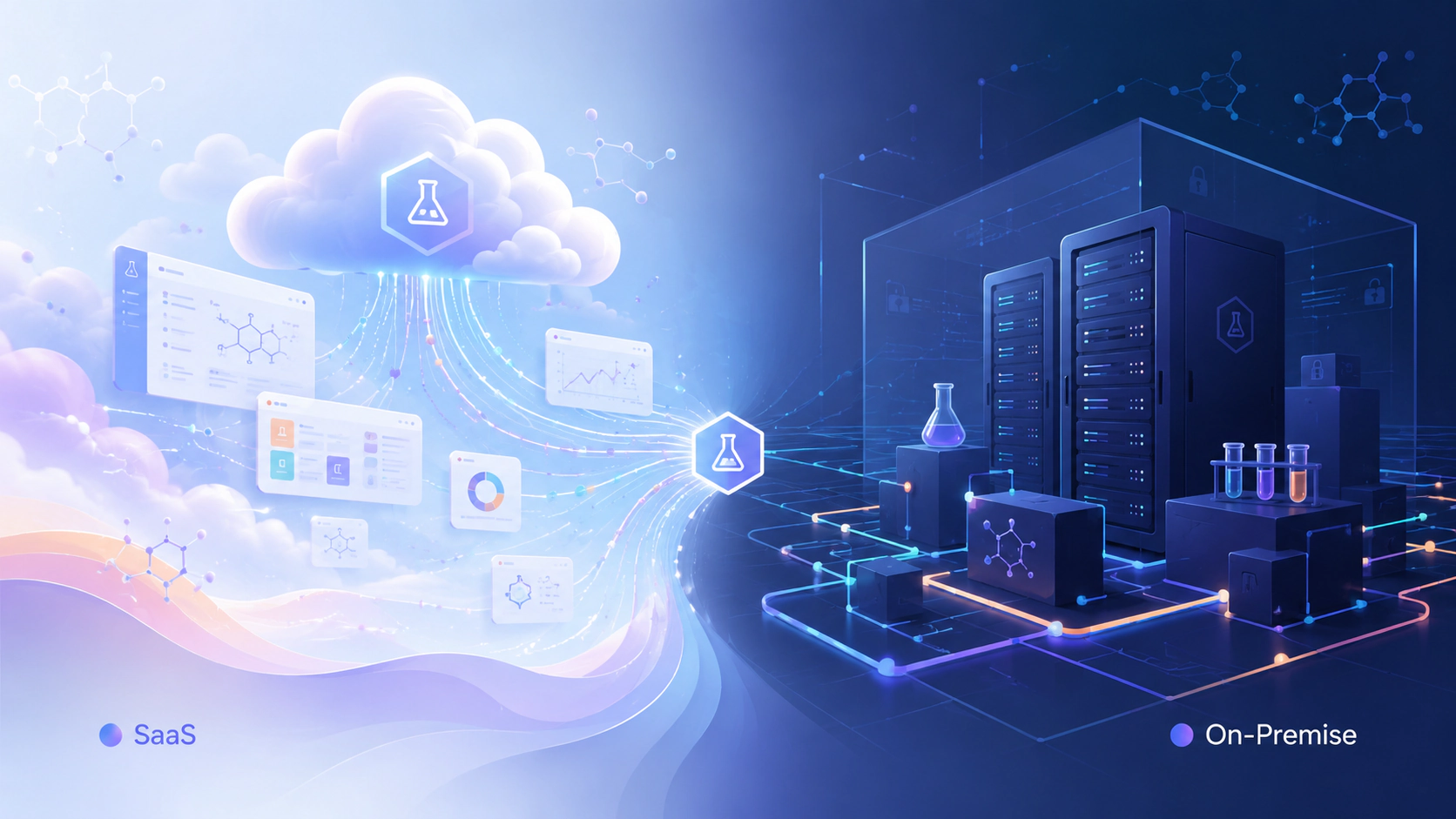
When choosing how to deploy eLabFTW, organizations usually compare two options: SaaS and On-Premise.
At first glance, the difference seems simple. With SaaS, the service is hosted and maintained by the provider. With On-Premise, the organization installs and operates the software on its own infrastructure.
Both models are valid. On-Premise can be the right choice for organizations with strict internal policies, dedicated infrastructure teams, or specific regulatory constraints. But in practice, the real difference is not only where the software runs. The real difference is who is responsible for keeping it secure, updated, backed up, and operational over time.